All posts by mkidd

Alumni Stories – Johnathan Smith

During my second year at TTU I started taking chemistry courses as my free electives so I could have something interesting for my spare classes. After a couple of years I was interested enough in chemistry to look at attending an REU program for a summer.  I ended up with an REU position doing inorganic chemistry at Virginia Tech for a summer.  During my final year at TTU I took a dual path considering graduate school positions in both chemistry and physics programs.  In the end the chemistry graduate programs looked more interesting to pursue after I finished with my physics degree from TTU.
I ended up choosing a program at Indiana University doing physical chemistry.  The area I went into was focused on building new analytical instrumentation, mass spectrometers in particular.  In graduate school I spent most of my time working toward improving an area of mass spectrometers known as charge detection mass spectrometers and established a new way of operating the detectors that substantially lowered the detection limits over previous efforts.  In practice, after the initial ideas, I put a lot of time into building and developing electronic circuits, designing detectors and vacuum systems, writing computer code, and working on signal processing algorithms.  I had other side projects come up during that time as well.  These included developing a Monte Carlo simulation program for studying charge migration in liquid water and a (cheap) sub-microsecond high-speed photography system for analyzing electrospray sources used in mass spectrometers.  I’m very happy to have had a physics background as preparation for all of the research I did.
I’m now employed at Thermo Fisher Scientific in the R&D section developing a new mass spectrometer detector.  On a day to day basis I’m on a small team that has a couple of scientists along with several engineers and technicians working together to finish a project.  As a scientist on the project I have to be the person that understands every element of the project and make sure that in the end we can do science with the new detector.  This roughly breaks down into a couple parts.  The first is to figure out a new or better way to detect ions, at a high level, figuring out some properties that would benefit the science that can be done with the instrument.  This has led me to have the chance to meet and work with world experts in signal processing, help develop computer simulation tools, figure out complicated ion movement in dynamic electric fields, and generally lots of reading to know what’s been done and get new ideas.  The next step is to figure out how to implement an idea, which involves working with engineers and technicians to get designs completed and built as well as writing a lot of computer code.  But I’ve also had the chance to pioneer a bit into 3D printing parts and delve into high-performance computing on multiple platforms including GPUs.
Johnathan Smith graduated from TTU in 2006.   He earned his PhD in Chemistry from Indiana University in 2011.
Alumni Stories – Patrick O’Malley

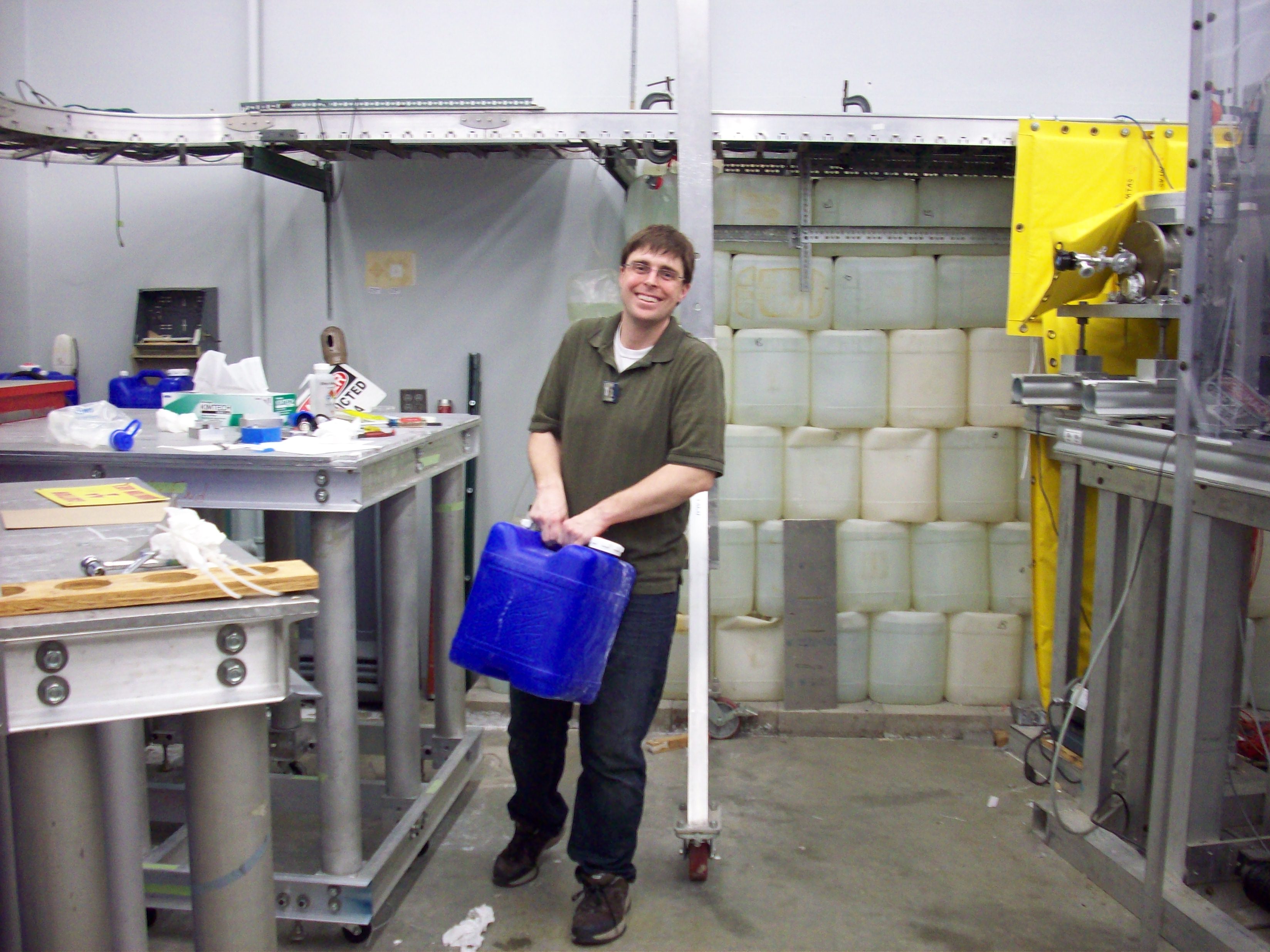
Understanding the origin of elements in the universe is one of the main goals of nuclear science and astrophysics today. Achieving this goal involves determining how the elements and their isotopes formed and being able to predict their abundances. In order to accomplish this, we must determine how the elements and their isotopes formed and be able to predict their abundances. Completely solving this problem is beyond the scope of any one research program. The exact origins of every nuclei are still a mystery, but the majority are believed to be produced in stars at various stages of their life. I work in a community of scientists who utilize their various skills and strengths to help answer this simple, yet difficult question.

17F_dn_setup

For example, an observational astronomer might look at the light it views from a star and be able to deduce what the elemental and isotopic composition of the surface of that star. As a nuclear experimentalist I work in laboratories where we strive to understand the reactions that likely occurred to produce the type and quantity of isotopes observed by the astronomer. More accurately, my goals are to study structure of the nuclei of interest and measure their specific properties. This information is key to producing accurate models of stellar processes believed to create at least some of the thousands of known isotopes.

borated_water_stacking

Dr. Patrick O’Malley graduated from TTU in 2006.  He earned his Ph.D in Experimental Nuclear Physics from Rutgers in 2012.  He is currently a Postdoctoral Research Associate at Notre Dame University.

TTU Students at Oak Ridge National Laboratory

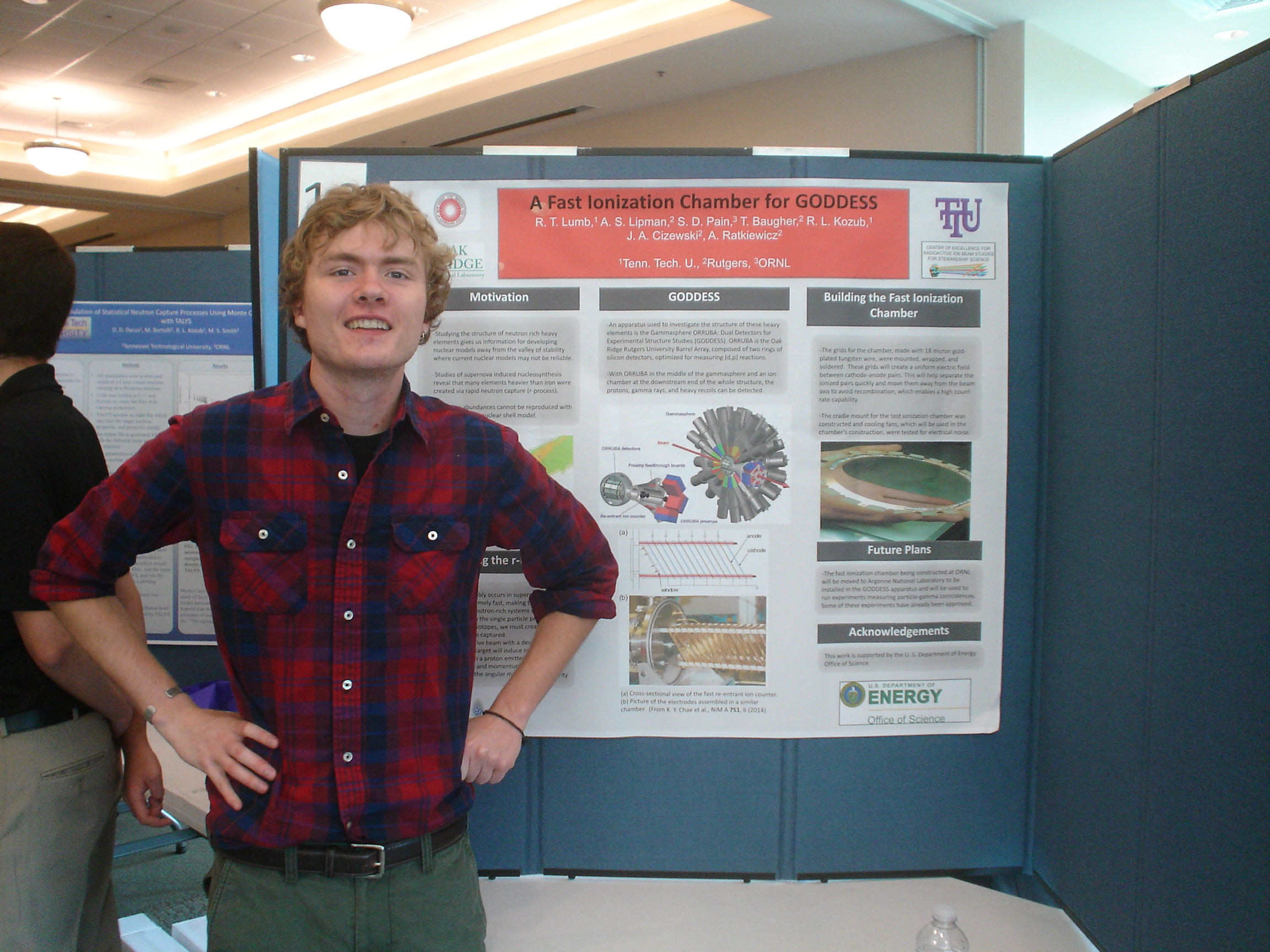
Three Tennessee Tech Physics students were involved in research experiences at Oak Ridge National Laboratory (ORNL) this summer:  Drew Dycus (physics major), Natã Franco Soares de Bem (engineering exchange student), and Rowan Lumb (physics major).  They were mentored by Dr. Ray Kozub and other scientists at ORNL.

Drew and Natã summarize their experiences below.

Drew Dycus

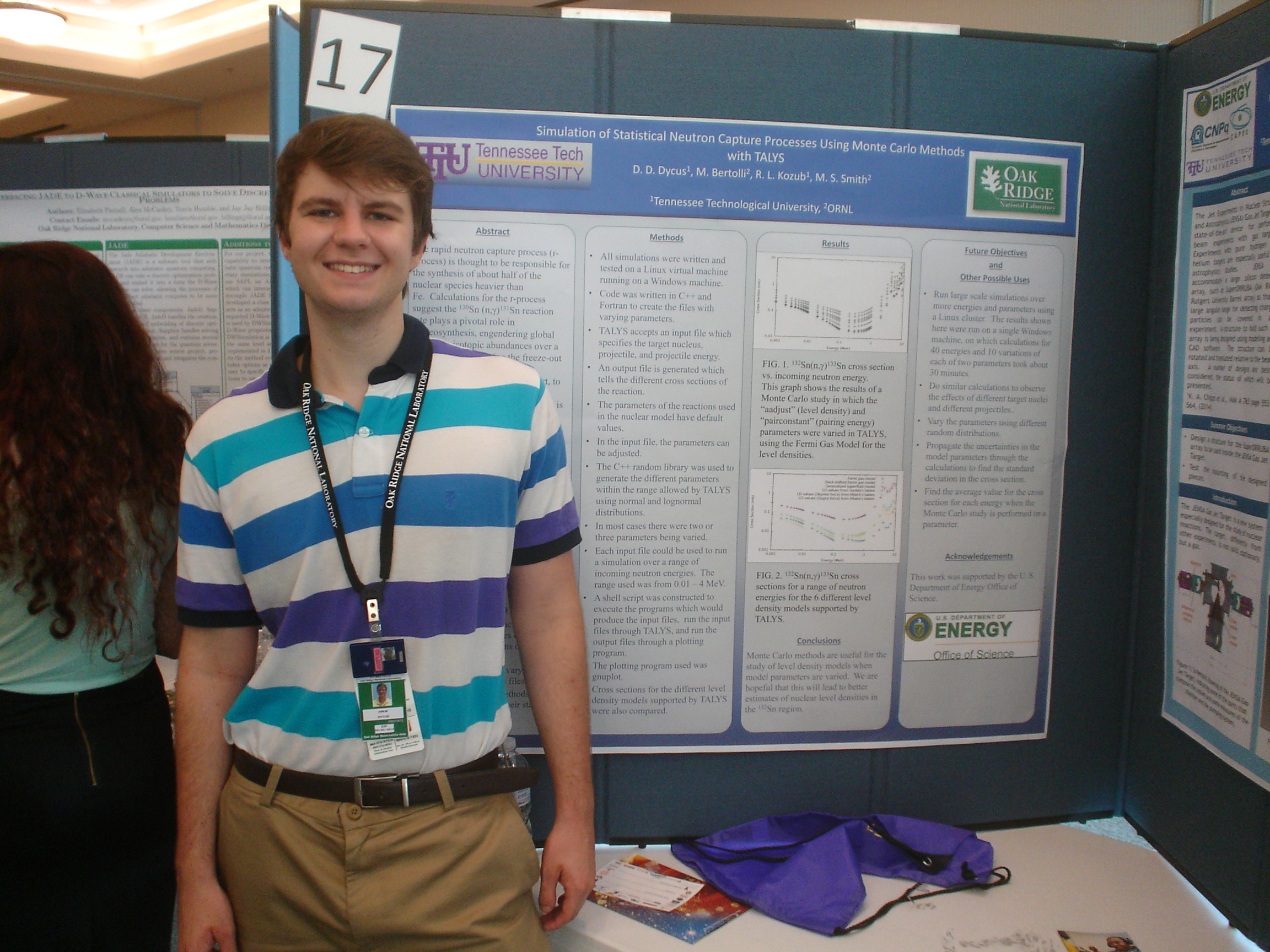
My research at ORNL this summer consisted of writing code for executing nuclear reaction simulations using Monte Carlo methods. In the beginning I had to receive my radiological worker training in order to access certain buildings in the site that contained radioactive sources. The research itself involved writing codes to create randomly distributed values that would be used as input for a nuclear reaction program called TALYS. An incomplete template input file was used to create many input files with parameters that were varied in their allowed range using normal and lognormal distributions . A script was written to automate the execution of the programs. TALYS created output files which gave the cross section values for the reactions which are used for understanding the r-process that is believed to happen in nova explosions.

Natã Franco Soares de Bem

Natã is a Control and Automation Engineering student at CEFET/MG (Brazil) and an exchange student at Tennessee Tech University.

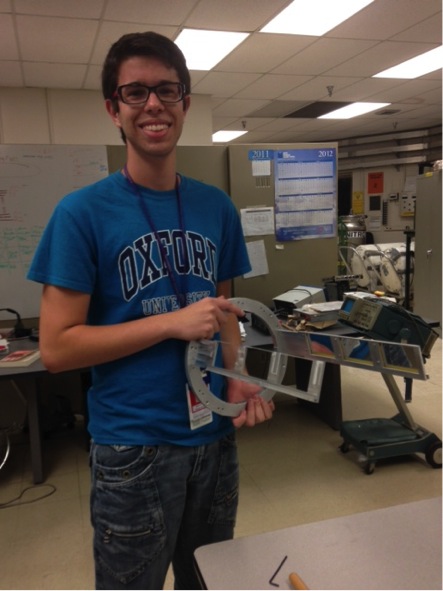
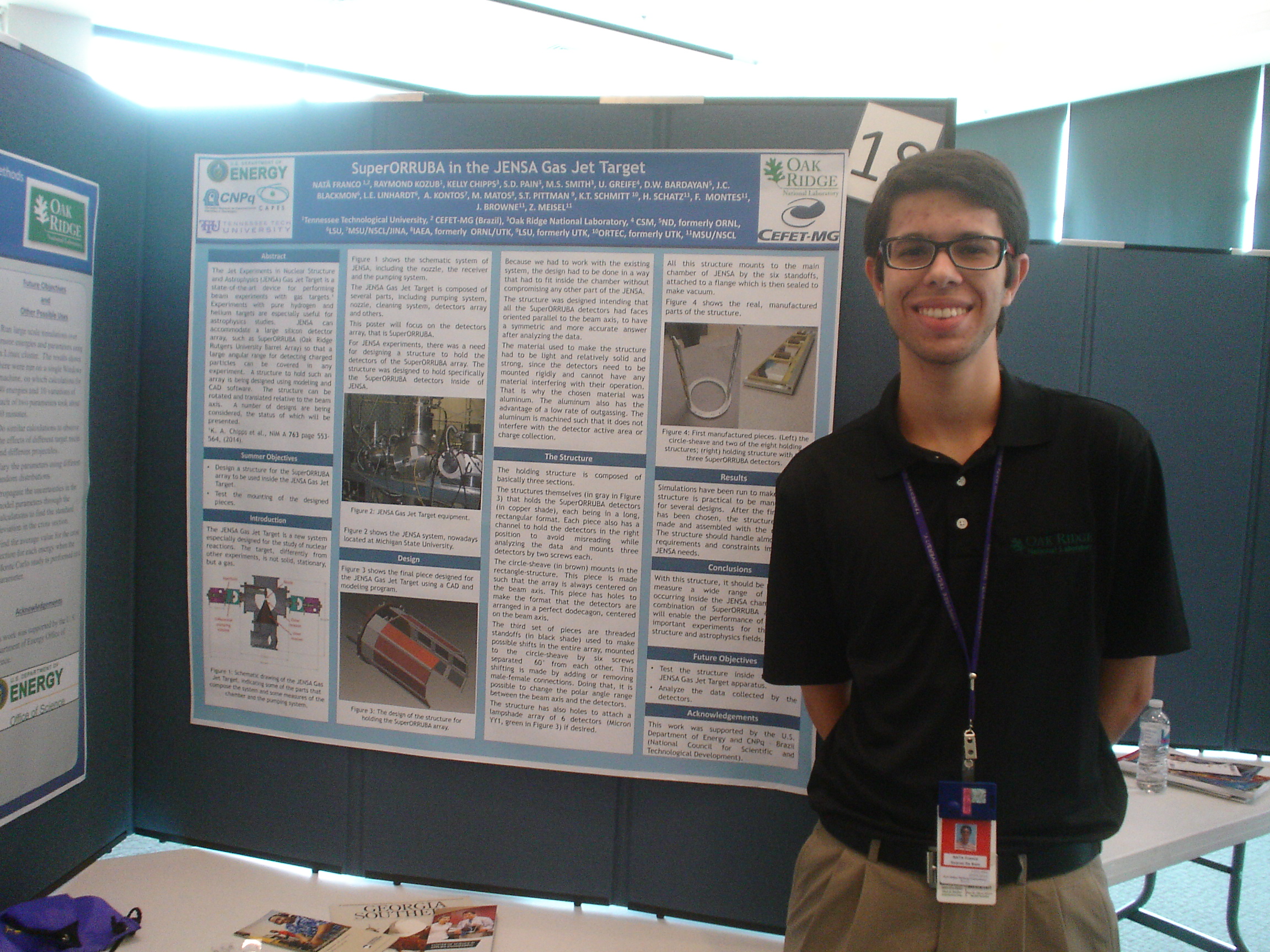
During this summer, I worked trying to design a structure to hold the SuperORRUBA detectors inside JENSA (Jet Experiments in Nuclear Structure and Astrophysics) chamber. After some attempts, the final design was chosen as shown in the picture. It was a little hard to work with something that I did not have familiarity with (astrophysics) but together with my mentors I was able to progress and come out with this final piece. Now, this design is going to be mounted inside JENSA, at Michigan State University, to see how it behaves in the real chamber. I am extremely happy for having the opportunity to work in something so interesting, modern and unique!

Natã is holding the structure he designed for the SuperORRUBA detectors.

Drew, Natã, and Rowan presented posters at the ORNL poster session.

Drew Dycus
Drew Dycus
Natã Franco Soares de Bem
Rowan Lumb
Rowan Lumb

Many research opportunities are available for undergraduates through the TTU Physics department.  If you are interested, please speak to any professor in the Physics department for more details.