Understanding how fish interact with their surrounding flow is essential to elucidating the physical mechanisms underlying aquatic locomotion, orientation, and schooling. Our research combines experimental flow visualization, computational fluid dynamics, and theoretical modeling to investigate interactions between swimming fish and the surrounding fluid.
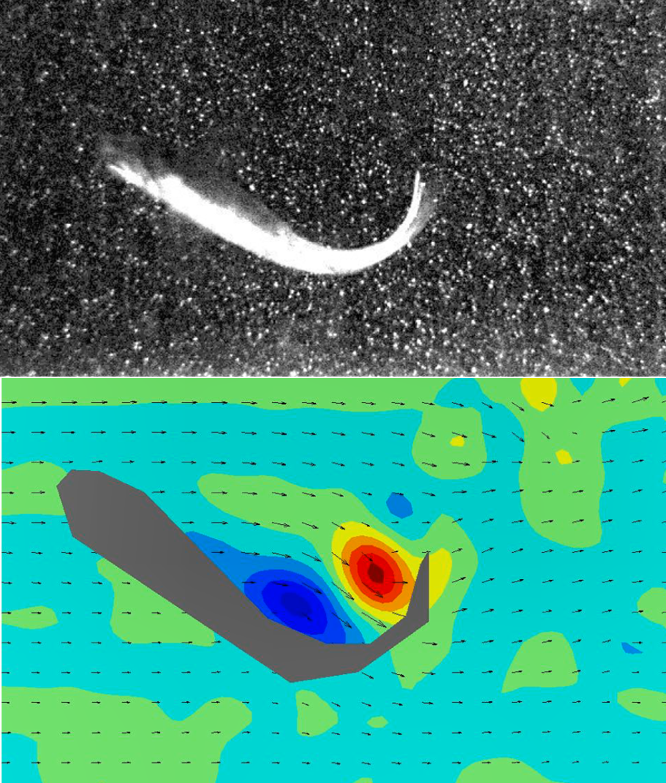
Using particle image velocimetry (PIV), we experimentally quantified the flow field around live zebrafish swimming against a water current. These measurements revealed the role of flow speed on tail beat undulations, heading direction, and swimming speed. Our findings on zebrafish hydrodynamics offer a precise quantification of vortex shedding during zebrafish swimming and demonstrate that locomotory patterns play a central role on the flow physics.
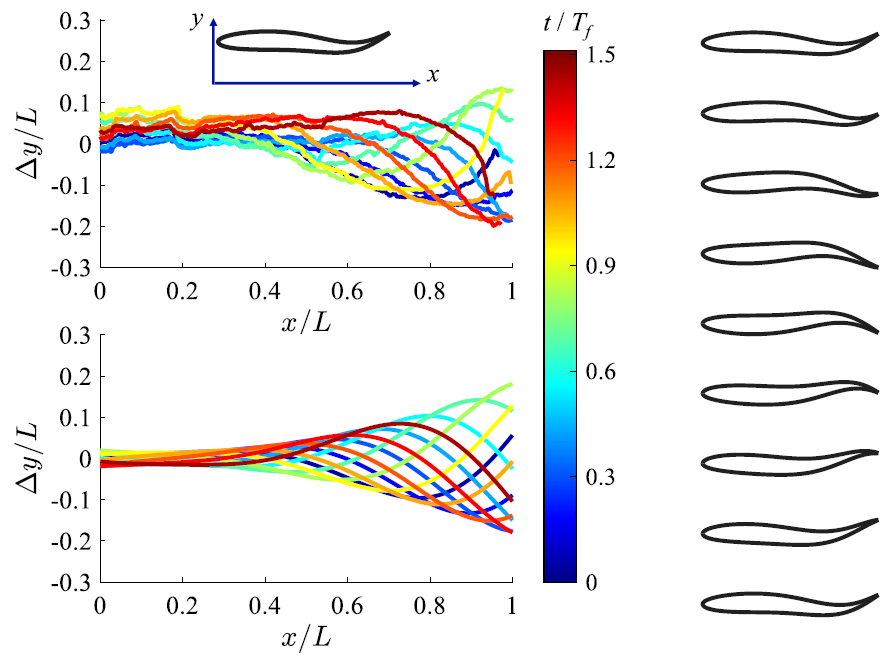
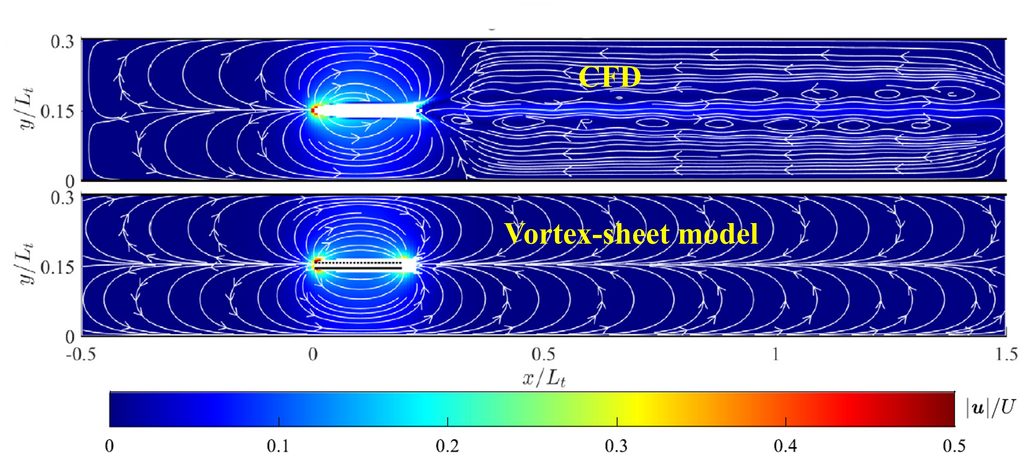
Building upon these experiments, we developed reduced-order mathematical models to capture the bidirectional coupling between fish and the surrounding fluid. By modeling a fish as a vortex dipole in an infinite channel with an imposed background flow, we investigated the mechanisms underlying rheotaxis, the tendency of fish to orient against an incoming current. We further extended the model by replacing each vortex in the pair with a vortex sheet along the fish body to describe the flow field around a fish undergoing carangiform swimming. The vortex sheets model could successfully predict the fluid flow around the swimming fish for a range of background flow speeds and channel widths. The proposed model shows improved accuracy at the cost of a mildly increased computational effort, thereby constituting an ideal basis for research on fish hydrodynamics.
Selected publications
- Zhang, P., Peterson, S., Porfiri, M., 2023: “Dipole- and vortex sheet-based models of fish swimming”, Journal of Theoretical Biology, 556, 111313.
- Porfiri, M., Zhang, P., Peterson, S., 2022: “Hydrodynamic model of fish orientation in a channel flow”, eLife, 11, e75225.
- Mwaffo, V.*, Zhang, P.*, Romero Cruz, S., Porfiri, M., 2017: “Zebrafish swimming in the flow: a particle image velocimetry study”, PeerJ, 5, e4041.