

Dr. Anton has been named the Energy Harvesting Symposium Chair for the 2016 ASME Smart Materials, Adaptive Structures, and Intelligent Systems conference. The conference will be held in Stowe, VT from September 28-30, 2016.
DSSL presents at 2015 ASME SMASIS Conference
DSSL presents one technical paper at the 2015 ASME Smart Materials Adaptive Structures and Intelligent Systems conference held September 21-23, 2015 in Colorado Springs, CO
- Contreras, C. E., Parkison, A. E., Wilson, B. E., Meneghini, R. M., and Anton, S. R., Geometric Effects on Embedded Piezoelectric Energy Harvester in Knee Replacement Bearing, Proc. ASME SMASIS, 2015, SMASIS2015-9063 (11 pp.)
DSSL welcomes Austin Scheyer
 DSSL welcomes MS student, Austin Scheyer. Austin graduated from Tennessee Tech with a BS in Mechanical Engineering in December, 2014. Welcome Austin!
DSSL welcomes Edward Tefft
 DSSL welcomes MS student, Edward Tefft. Edward graduated from Tennessee Tech with a BS in Mechanical Engineering in May, 2015. He previously conducted undergraduate research in DSSL. Welcome Edward!
DSSL welcomes Mohsen Safaei Mohammadabadi
 DSSL welcomes PhD student, Mohsen Safaei Mohammadabadi. Mohsen received the M.S. degree in Mechanical Engineering from Isfahan University of Technology in Iran and the B.S. degree in Mechanical Engineering from Yazd University in Iran. Welcome Mohsen!
Dr. Anton and Ryan Kettle spend summer at Eglin AFB
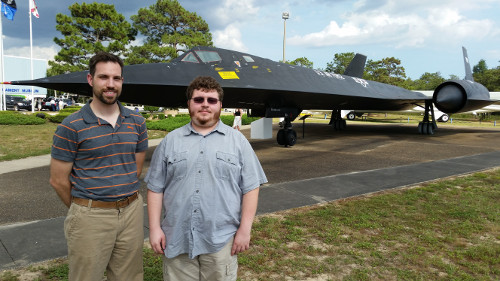 Dr. Anton and DSSL MS student, Ryan Kettle, spent the summer at Eglin Air Force Base near Destin, FL performing research as part of the Air Force Summer Faculty Fellowship program. Their work is on high speed detection of dynamic states in real-time. Photo is taken in front of a SR-71 Blackbird at the Air Force Armament Museum which currently holds the Air Speed Record for a manned airbreathing jet aircraft with a speed of 3,530 km/h (2,193 mph) set back in 1976!
Commencement – Spring 2015
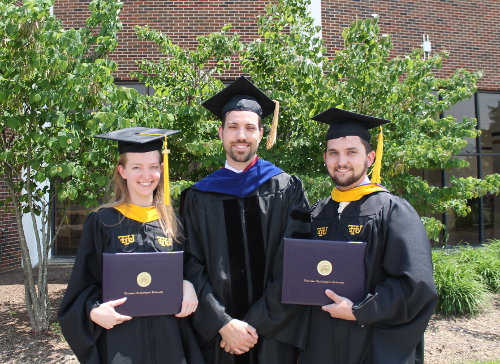 Congratulations to Brooke Wilson and Chase Ray who completed the requirements for the MS degree and participated in Commencement on May 9, 2015!
Kettle, Ray, Contreras receive Eminence Awards
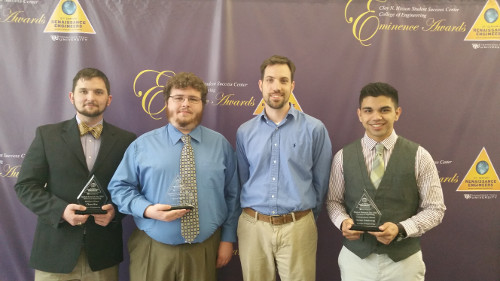 Three DSSL researchers were recognized at the 2015 College of Engineering Eminence Awards banquet for their excellence in research and teaching. Congrats Ryan, Chase, and Cesar!
- Ryan Kettle – Outstanding Teaching Assistant
- Chase Ray – Outstanding Graduate Research
- Cesar Contreras – Outstanding Undergraduate Research
Dr. Anton receives Faculty Research Grant
Dr. Anton has been awarded a Faculty Research Grant for 2015-2016 from the Office of Research at Tennessee Tech titled “Integrated Sensing and Energy Harvesting in Total Knee Replacement Implants.“
Brooke Wilson defends her MS thesis
Brooke Wilson successfully defended her Masters of Science degree in Mechanical Engineering entitled “Modeling and Experimentation for Evaluation of Piezoelectric Sensors for In-Vivo Monitoring” on April 16, 2015. Congratulations Brooke!
Abstract:
The knee replacement is the second most common orthopedic surgical intervention in the United States, but currently 1 in 5 knee replacement patients are not satisfied with their level of pain reduction one year after surgery. It is imperative to make the process of knee replacement surgery more objective by developing a data driven approach to ligamentous balance, which increases implant life. In this work, piezoelectric materials are considered for both sensing and energy harvesting applications in the total knee replacement implants. This work aims to embed piezoelectric material in the polyethylene tibial component of a knee replacement unit to act as sensors that will aid in the alignment and balance of the knee replacement by providing intraoperative feedback to the surgeon. Postoperatively, the piezoelectric sensors can monitor the structural health of the implant in order to perceive potential problems before they become bothersome to the patient. Specifically, this work will discuss the use of finite element modeling coupled with uniaxial compression testing to prove that piezoelectric stacks can be utilized to harvest sufficient energy to power the sensors needed for this application. This work will show that energy on the order of 20 J can be generated over the course of a day.