

Ghattas receives Spectrum Award at E-Week Banquet
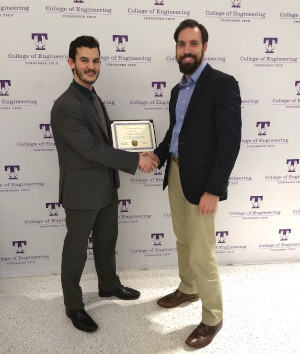 DSSL undergraduate researcher Nathan Ghattas was awarded the Engineering, Computing and Technology Spectrum Award for Mechanical Engineering at the 2019 Engineer’s Week banquet on February 21, 2019. The Engineering, Computing and Technology Spectrum Award recognizes a diverse body of students across all the degree-granting departments in the College of Engineering for their initiatives and achievements in educational, research, and professional development activities. Congratulations Nathan!
DSSL Presents at 2018 ASME SMASIS Conference
DSSL presents three technical papers and one technical presentation at the 2018 ASME Smart Materials Adaptive Structures and Intelligent Systems conference held September 10-12, 2018 in San Antonio, TX. Dr. Anton, Mohsen Safaei, Rob Ponder, and Justin Carlson were in attendance.
- Carlson, J., Tiberi, Z., Safaei, M., Ponder, R. I., and Anton, S. R., Parametric Testing of Surrogate Knee Replacement Bearings with Embedded Piezoelectric Transducers, Proc. ASME SMASIS, 2018, SMASIS2018-8037 (9 pp.)
- Ponder, R. I., Safaei, M., and Anton, S. R., Validation of Impedance-Based Structural Health Monitoring in a Simulated Biomedical Implant System, Proc. ASME SMASIS, 2018, SMASIS2018-8012 (8 pp.)
- Safaei, M. and Anton, S. R., Self-powered Multifunctional Instrumented Knee Implant, Proc. ASME SMASIS, 2018, SMASIS2018-8078 (11 pp.)
- Anton, S. R., Continuous, Real-Time State Detection in Highly Dynamic Environments, ASME SMASIS Conference, San Antonio, TX, September 11, 2018 (technical presentation)
DSSL Welcomes URECA! Researcher Ghattas
DSSL welcomes undergraduate URECA! (Undergraduate REsearch and Creative Activity) grant winner Nathan Ghattas to the lab. The title of Nathan’s research project is “Investigation of Mechanical Boundary Conditions on Impedance Based Structural Health Monitoring in a Biomedical Environment.”
Nathan Ghattas

DSSL Welcomes Eric Nolan
 DSSL welcomes MS student, Eric Nolan. Eric received the B.S. degree in Mechanical Engineering in 2018 from Tennessee Tech University. Welcome Eric!
Austin Scheyer defends his MS thesis
Austin Scheyer successfully defended his Masters of Science degree in Mechanical Engineering entitled “An Investigation into the Feasibility of Embedding Piezoelectric Sensors in Additive Manufactured Structures for Impedance Based Structural Health Monitoring” on June 25, 2015. Congratulations Austin!
Abstract:
Embedding sensors within additive manufactured (AM) structures gives the ability to develop smart structures capable of monitoring the mechanical health of a system. AM provides an opportunity to embed sensors within a structure during the manufacturing process. One major limitation of AM technology is the ability to verify the geometric and material properties of fabricated structures. Over the past several years, the electromechanical impedance (EMI) method for structural health monitoring (SHM) has been proven to be an effective method for sensing damage in structures. The EMI method utilizes the coupling between the electrical and mechanical properties present in piezoelectric transducers to detect a change in the dynamic response of a structure. A piezoelectric device, usually a lead zirconate titanate (PZT) ceramic wafer, is bonded to a structure and the electrical impedance is measured across a range of frequencies. A change in the electrical impedance is directly correlated to changes made to the mechanical condition of the structure. In this work, the EMI method is employed on piezoelectric transducers embedded within AM structures to evaluate the feasibility of performing SHM as well as detecting manufacturing errors. The fused deposition modeling (FDM) method is used to print specimens from polylactic acid (PLA) with an embedded monolithic piezoelectric ceramic disc for this feasibility study. The specimen is mounted as a cantilever while impedance measurements are taken using an HP 4194A impedance analyzer. After taking a baseline measurement of the healthy specimen, the Root Mean Square Deviation (RMSD) method is utilized as a metric for quantifying changes to the system. Both destructive and non-destructive damage is simulated in specimens by adding a tip mass and drilling a hole near the free end of the cantilever, respectively. The SHM method proved to be successful at detecting both destructive and non destructive damage. Manufacturing errors are simulated using a reduced infill percentage and internal voids to change the internal structure of specimens. The manufacturing errors proved to be more difficult to detect due to variation between responses from different specimens, though this method was still successful in detecting the manufacturing errors. ANSYS is used to model both free and embedded PZTs to simulate piezoelectric materials under various conditions. Free PZTs are modeled in both 2D and 3D simulations. Embedded PZT models with no damage and both non-destructive and destructive damage are simulated in 3D. ANSYS proved to be highly accurate when modeling a free PZT in both 2D and 3D models. The embedded PZT models with no damage and destructive damage showed promising results, though it had a frequency shift with respect to the experimental data. The simulation of non-destructive damage also showed promising shifted results, though in some areas it was slightly erratic.
Commencement – Spring 2018
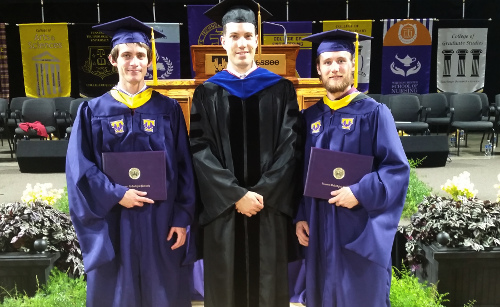 DSSL saw four MS students graduate during the Spring 2018 term. Pictured are MS student Edward Tefft (left), Dr. Anton (center), and MS student Austin Scheyer (right) at the commencement ceremony.
Carlson and Tiberi receive Best Poster Award at TTU Research Day
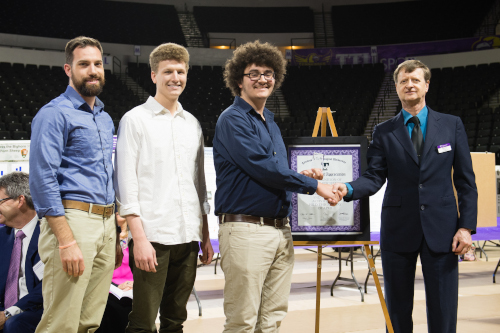 DSSL undergraduate researchers Justin Carlson and Zach Tiberi received the Best Poster Award for undergraduate research in Mechanical Engineering at the 2018 TTU Research and Creative Activities Day. Justin and Zach presented a poster entitled “Simulating Gait Cycle for Total Knee Replacement with Embedded Piezoelectric Transducers” Congratulations Justin and Zach!
DSSL presents at 2018 TTU Research and Creative Activities Day
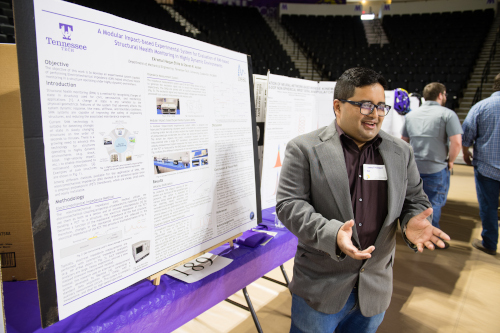 DSSL researchers Mohsen Safaei, Rob Ponder, Ekramul Ehite (pictured), Justin Carlson, and Zach Tiberi presented posters at the 2018 TTU Research and Creative Activities Day on April 10, 2018. The event is an effort to emphasize the significance of research in postsecondary education; and to recognize the diverse areas of research unique to the different disciplines. Participants from all colleges in the university are welcome to present their research.
Ekramul Ehite defends his MS thesis
Ekramul Ehite successfully defended his Masters of Science degree in Mechanical Engineering entitled “Experimental Investigation of Electromechanical Impedance-Based Structural Health Monitoring in Highly Dynamic Environments” on April 4, 2018. Congratulations Ehite!
Abstract:
Structural Health Monitoring (SHM) is a damage detection strategy widely used for monitoring the state of engineering structures. The Electromechanical Impedance (EMI) method utilizing piezoelectric (PZT) materials is one of the most common techniques for applying SHM. Contemporary SHM technologies for characterization and assessment of in-service structures are suitable for detecting incipient damage in slowly changing structures on the order of seconds to minutes. There is a growing need to advance this technology for structures operating in highly dynamic environments (e.g. shock, blast, high-velocity impact, hypersonic flight, etc.) to enable microsecond to millisecond detection.
In this study, the application of the EMI method for continuous monitoring of changes of state in dynamic environments is investigated. A modular impact-based experimental system (MIES) is designed, which creates a dynamic event in the form of a collision between a pneumatically actuated moving striker bar and an instrumented static incident bar at different impact velocities. The parameters of the system including the impact velocity, incident bar boundary conditions, and the striker bar dimensions and material are made user-configurable. The velocity of the striker is measured by a photoelectric sensor-based measurement system. The incident bar is instrumented with a single PZT transducer, and the PZT is excited using both single-tone and multi-tonal excitation signals. The impedance of the PZT is measured by an EMI-based impedance measurement system. The velocity data is used to verify the capability of the system to generate customized, repeatable impact events. The impedance data using single-tone excitation signals at different impact velocities show that the impact causes a significant change in the PZT impedance signature, resulting from a corresponding change in the dynamic system state of the incident bar. The impedance data using multi-tonal excitation signals show a similar change in the PZT impedance signature, while allowing multiple frequencies to be monitored simultaneously, thereby providing more information about the system without increasing the measurement time. The overall results indicate that the experimental system can be potentially used for continuous evaluation of system state in highly dynamic environments by combining it with a rapid data acquisition and processing system capable of operating in the microsecond to millisecond scale.